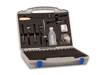
Equipment for non-destructive testing of water absorption and effectiveness control of hydrophobic impregnations
Long-lasting protection from
driving rain and moisture
driving rain and moisture
Ecological responsibility
The entire Funcosil range is formulated to be PFAS-free,
and most of the products are water-based.
and most of the products are water-based.
As an internationally active manufacturer of products for the protection and preservation of buildings, Remmers is highly conscious of its responsibility towards people and the environment. This is why, in addition to meeting the very highest standards of technical performance, we focus on ecological responsibility, sustainable development and reducing hazardous materials in order to protect people's health.
Traditionally, fluorinated substances known as PFAS (per- and polyfluoroalkyl substances) are added to hydrophobic impregnation agents in order to give them certain properties. Some of these materials harbour significant hazards to health and the environment, and are therefore no longer added to Remmers products.
Remmers uses new, modern formulations that contain no PFAS – and no aliphatic or aromatic hydrocarbons either. By systematically cutting out hazardous materials, we are actively working towards better protection for health and the environment.

Funcosil hydrophobic creams:
Simple and efficient moisture protection
Hydrophobic treatments in cream form significantly increase the contact time between the active ingredient and the surface of the building material. This means that, with just a single application, a high penetration depth and degree of absorption can be achieved, resulting in long-lasting protection against moisture. However, the key advantage of cream-based products is that they can be applied with virtually no waste, even when working overhead, and the amount applied can be controlled very easily. The creamy consistency of Remmers Funcosil cream hydrophobic agents ensures a long contact time on the surface of the building material. The active substances are absorbed into the material during this time. The resulting high penetration depths lead to greater, longer-lasting protection against the ingress of water and pollutants. Funcosil hydrophobic creams are setting new standards for the cost-effective hydrophobic treatment of façade surfaces.

Benefits at a glance
- Easy to apply accurately with no material loss, even when working overhead
- Low material use per m² in just one application
- No losses due to runoff
- No need for time-consuming additional work

Liquid Funcosil impregnating agents:
The classic solutions
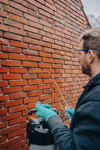
Liquid impregnation agents are preferably applied in a pressureless flow penetrating procedure. This keeps aerosol generation to a minimum to protect workers. The façade is soaked in such a way that a 30 to 50 cm long film of liquid runs down the building element. This method ensures that the hydrophobic agent can penetrate deep into every pore, every recess and every crack. By repeating the process up to two times as recommended, maximum penetration depths and excellent long-term stability are achieved, especially on porous, highly absorbent substrates.
That is what makes façades treated in this way so durable. All low-pressure, delivery and spraying devices as well as liquid pumps can be used for the application. In the case of solvent-based products, the equipment must be explosion-proof. To avoid defects, contiguous areas – including adjacent areas – must be treated in one continuous process.
Benefits at a glance
- Excellent penetration depth
- Tried-and-tested technology that has been used for more than 70 years
- Cost-effective and efficient
Water is the main culprit:
Damp façades and the consequences
Water plays a central role in the weathering of mineral building materials
When moisture enters a building material:
• the absorption of pollutants increases!
• frost damage can occur!
• the perfect conditions are created for algae, moss and other microorganisms to grow!
• the thermal insulation effect decreases significantly!
How does hydrophobic treatment help with this?
Hydrophobic impregnations significantly reduce the capillary water uptake of a façade that is caused by rain and splashing water. That’s why hydrophobic treatment is a sensible measure for preventing damage. A hydrophobic impregnation makes the treated building material water-repellent, without impairing the open porosity and thus the vapour permeability.
Water-repellent and vapor-permeable -
How does that work?
This phenomenon can be explained with the aid of a simple experiment. A thin glass tube is placed in a beaker of water, causing the water to rise up into the tube. The mechanism behind this is the capillary forces. If the glass tube is now made hydrophobic, this effect is reversed; water is no longer “sucked in” but rather forced out. This is the result of only a single-molecule, nanoscale layer of the hydrophobic agent on the pore walls, meaning that the open cross-section required for vapour diffusion remains virtually unrestricted. Air and water vapour can pass through as before.

Moisture protection is heat protection
Water is thermally conductive. This means that reducing the moisture content in a building material always leads to an improvement in its thermal insulation properties.
On damp brick façades, hydrophobic impregnation is therefore the first port of call if you’re looking for a cost-effective way to reduce energy consumption and thus heating costs. Another positive side effect that also helps to combat global warming is the reduction of carbon emissions in the building. In addition, making single-layer brick façades water repellent often leads to a significant shift in the dew point, thereby reducing the risk of mould growth indoors.

Benefits of hydrophobic treatment
• Reduces the energy consumption of the building
• Reduces CO₂ emissions
• Reduces the risk of mould growth
• Reduces CO₂ emissions
• Reduces the risk of mould growth
Funcosil Test Kit
Equipment for non-destructive testing of water uptake and effectiveness check of hydrophobic impregnations
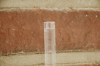
Non-destructive testing with the Funcosil test tube designed by Dr.-Ing. Karsten provides information about the absorption behaviour of a component or building material when exposed to driving rain. Dr.-Ing. Karsten’s water uptake test is suitable for use on the building site and in the laboratory. The test can be carried out on all level, capillary-active or hydrophobic substrates.
Remmers recommends performing this test to check the effectiveness of hydrophobic treatment measures. Measurements taken before and after treating a façade indicate how well the hydrophobic agent reduces water uptake upon exposure to driving rain.
The water uptake rates determined can be used as reference values for building physics calculations. In addition, potential defects, such as cracks or joint intersections, can be checked non-destructively in situ.
Brochure Funcosil Hydrophobic Treatments
Our comprehensive brochure on the topic of Funcosil hydrophobic treatments explains facts and offers long-lasting and efficient solutions against driving rain and damp facades.